The short answer
EN 18031 is the series of harmonised standards for the cybersecurity requirements of the EU Radio Equipment Directive, which apply to internet-connected and certain other radio equipment placed on the EU market since 1 August 2025. Part 1 covers network protection, part 2 personal data and privacy, part 3 fraud protection. The standards were cited with restrictions: if your device lets users skip setting a password, for example, the standard gives no presumption of conformity. For units placed on the market from 11 December 2027, the Cyber Resilience Act replaces these requirements. Track the scope decision, each requirement, its evidence and those dates as linked work.
Who is this for?
This guide is for engineering leads, firmware leads and certification or compliance leads at teams that build Wi-Fi, Bluetooth, cellular or other radio products for the EU market. It explains what the cybersecurity requirements of the EU Radio Equipment Directive (RED) and EN 18031 ask of your product, which decisions change your certification path, and how to keep the scope, requirements, evidence and dates in Jira so the assessment isn’t rebuilt from email every time something changes.
We’re an Atlassian consulting firm, not a test lab or a notified body (an independent organization the EU designates to assess products). Your certification lead, your test lab and, where needed, your notified body decide how the requirements apply to your product. This guide shows how to make their work traceable.
The example
The screens come from a sample space on our test site. It belongs to a fictional team building a connected indoor air-quality monitor: a main board with a Wi-Fi module, firmware, a phone app and a cloud dashboard. The team plans to place the first units on the EU market in May 2027, which is before the main obligations of the Cyber Resilience Act (CRA) apply. The same team is the worked example in our guides to EVT, DVT and PVT and planning electronics, firmware and mechanical work in one Jira project. All names, dates and numbers are made up.
What do the RED cybersecurity requirements cover?
The Radio Equipment Directive (2014/53/EU) has three essential requirements on cybersecurity in Article 3(3). Commission Delegated Regulation (EU) 2022/30 made them apply to certain categories of radio equipment, and they apply from 1 August 2025 (the date was moved from 1 August 2024).
| Article | What it asks for | Harmonised standard |
|---|---|---|
| 3(3)(d) | The equipment doesn’t harm the network or its functioning, or misuse network resources | EN 18031-1:2024, internet-connected radio equipment |
| 3(3)(e) | The equipment has safeguards to protect the personal data and privacy of the user and subscriber | EN 18031-2:2024, radio equipment processing data: internet-connected, childcare, toy and wearable radio equipment |
| 3(3)(f) | The equipment supports features that protect against fraud | EN 18031-3:2024, internet-connected radio equipment processing virtual money or monetary value |
The Commission’s Guide to the RED explains two terms that decide scope. “Internet-connected radio equipment” is radio equipment that can communicate itself over the internet, whether directly or via other equipment, such as a phone or a gateway. “Wearable radio equipment” means devices worn on the body or clothing that monitor and register sensitive data, such as fitness trackers and smart watches; a smartphone held in the hand isn’t a wearable in this sense.
Some products are excluded, for example medical devices under the EU medical device regulations, and some vehicle and aviation equipment from parts of the scope. Check the delegated regulation itself for the full list.
What is EN 18031, and how is it structured?
EN 18031 is a series of three harmonised standards from CEN and CENELEC, one per article. Their references were published in the Official Journal on 30 January 2025, through Commission Implementing Decision (EU) 2025/138.
Each standard is organized around security mechanisms. The clauses that the Commission’s guidance discusses give a sense of the structure: access control mechanisms (including the clauses for toy and childcare equipment in part 2), authentication with rules on passwords (clauses 6.2.5.1 and 6.2.5.2 in all three parts), and secure update (clause 6.3.2.4 in part 3). Each requirement comes with assessment criteria, plus sections named “rationale” and “guidance” that explain the risk and give implementation examples.
Two practical consequences for the team:
- Every requirement needs a decision. For each one, you record whether it applies to your product, how the product meets it, and what evidence shows that. “Doesn’t apply” needs a reason too.
- The rationale and guidance sections aren’t requirements. The Commission’s guidance says they are informative and don’t give a presumption of conformity. Don’t build your evidence on them; build it on the requirements and assessment criteria.
Which restrictions decide whether you need a notified body?
The standards were cited in the Official Journal with restrictions. The European Commission’s guidance on applying EN 18031 explains four of them:
| Restriction | Applies to | What it means in practice |
|---|---|---|
| 1. Rationale and guidance sections give no presumption of conformity | All three parts | Informative only; no third-party assessment needed because of this |
| 2. No presumption if, under clauses 6.2.5.1 and 6.2.5.2, the user is allowed not to set and use any password | All three parts | Don’t offer a “skip password” option. If you do, a notified body is needed |
| 3. No presumption for toy and childcare equipment if parental or guardian access control isn’t ensured | EN 18031-2 | Implement parental or guardian control, or go to a notified body |
| 4. No presumption for the secure update assessment criteria in clause 6.3.2.4 | EN 18031-3 | Third-party assessment is mandatory whenever this clause applies |
The same guidance answers the question most teams ask first: self-assessment (Module A, internal production control) is allowed only if the relevant EN 18031 standards are applied and the product isn’t affected by these restrictions. Otherwise, the product needs a notified body competent for these requirements, which issues an EU-type examination certificate.
That turns a few design decisions into certification decisions. Whether the setup flow lets someone skip the password is a product question in a sprint, and it decides whether you need a notified body. That’s why it belongs in Jira as a tracked requirement, not in a test report written after the design is frozen.
What changes on 11 December 2027?
The Cyber Resilience Act (Regulation (EU) 2024/2847) entered into force on 10 December 2024. Its reporting obligations apply from 11 September 2026, and its main obligations from 11 December 2027.
On 16 February 2026, the Commission adopted Delegated Regulation (EU) 2026/339, which repeals Delegated Regulation 2022/30 as of 11 December 2027, to avoid overlapping requirements. The Commission’s RED Guide (October 2026) says radio equipment placed on the EU market on or after 11 December 2027 is subject to the CRA for cybersecurity, not to Article 3(3)(d) to (f) of the RED, without prejudice to the CRA’s transitional provisions.
For a product team, that means two dates on one plan:
- Units placed on the market before 11 December 2027 follow the RED cybersecurity requirements, with EN 18031 as the usual route.
- Units placed on the market from 11 December 2027 follow the CRA, which adds obligations such as vulnerability handling and security updates over a support period.
A product launching in 2027 can sit on both sides of that line. Our example team launches in May 2027 under the RED, and every unit shipped from mid-December onward falls under the CRA. Much of the EN 18031 work carries over, because the risks are the same, but the assessment and documentation have to be redone against the new rules.
What should you track?
This is what we track for teams in this situation. It’s our practice, built on the sources above, not a template from a standard.
| What | Why it matters | In Jira |
|---|---|---|
| The scope decision | Which articles and EN 18031 parts apply, and why | One work item, done, with the reasoning written down |
| Each applicable requirement | What the product must do, in product terms | A Requirement work item, with the EN 18031 clause where it helps |
| The restricted options | Passwords, parental control, part 3 secure update | Requirements that state the restricted option isn’t used |
| Evidence per requirement | Tests, inspections, design documents | Test work items linked with “is verified by” |
| The conformity route | Module A, or a notified body and why | A decision work item, re-opened if the design changes |
| The technical documentation | What goes to the file and the lab | A task with links to all of the above |
| Market dates | RED before 11 Dec 2027, CRA from that date | Releases and a dated CRA readiness item |
| Changes after assessment | A changed setup or update flow can change the route | A saved search for requirements changed after sign-off |
The first item is the one teams skip. In our example, the scope decision is a work item of its own: who decided, when, which articles apply and why, and which standards follow.
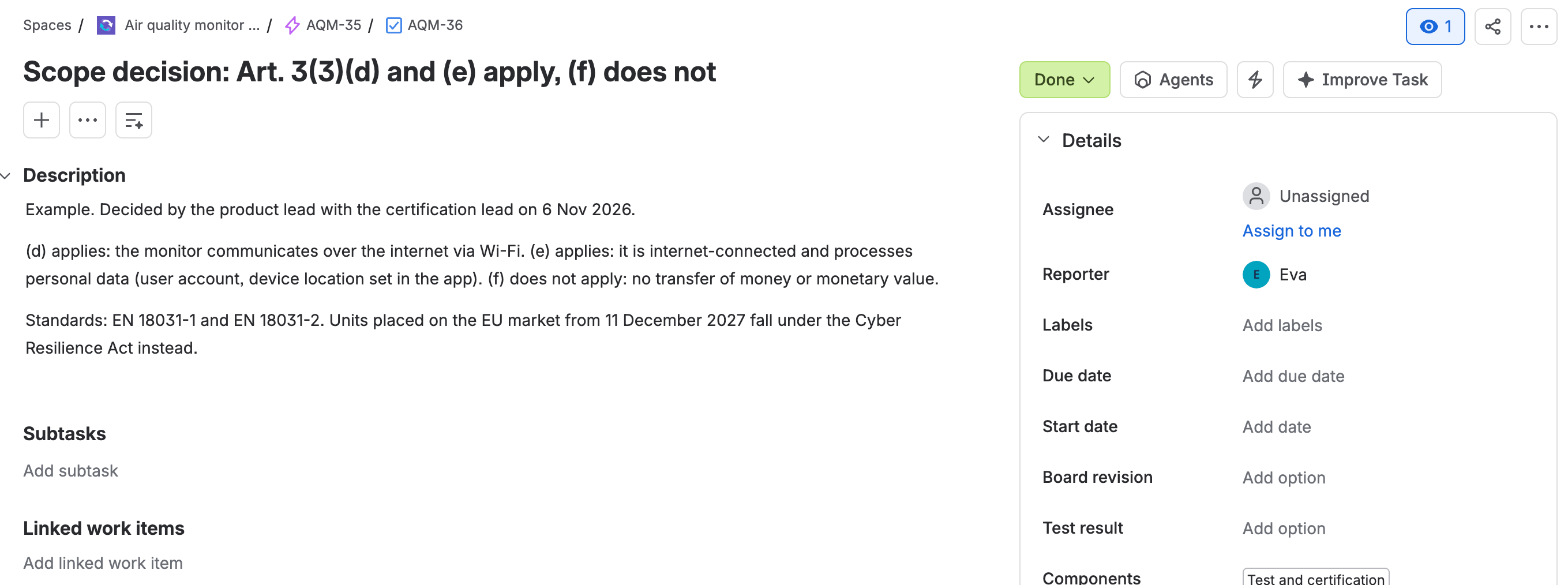 Example: the scope decision as a work item. When someone asks “why part 2?”, the answer is one link away.
How do you set it up in Jira?
This builds on the setup in our guide to planning disciplines in one Jira project: one space, components per discipline, builds as releases.
- An epic for the assessment, tied to the release in which units first reach the market. In our example: “RED cybersecurity: EN 18031 assessment for Launch 1.0”.
- A Requirement work type for the security requirements, separate from stories. A story closes when the work is done; a requirement stays, with its evidence.
- Requirements written as product behavior, with the discipline that owns them as the component: “Firmware images are signed; the bootloader rejects unsigned or modified images” says more to a firmware engineer, and to a lab, than a clause number alone.
- One requirement for each restricted option, worded so the decision is visible: “Every device ships without a universal default password; the user sets one at setup”, with the note that no skip option exists.
- Tests linked with “is verified by”, carrying a result and the board revision they ran on.
- A conformity route decision as its own work item, with the rule that it’s re-opened when the authentication, update or network behavior changes.
- A dated CRA readiness item for the units you will ship after 11 December 2027.
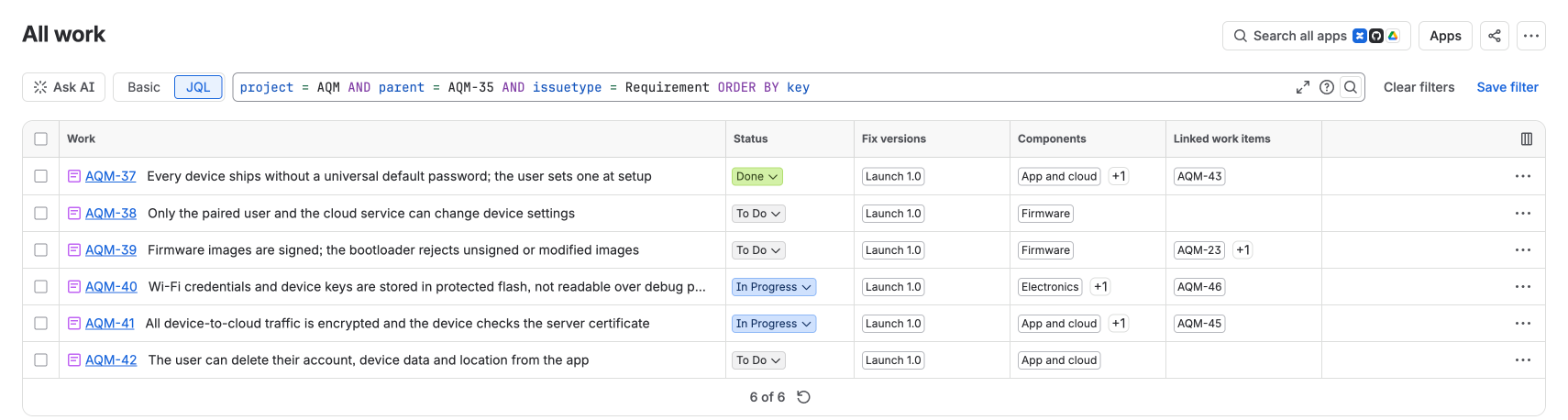 Example: six requirements, each owned by a discipline, each with its evidence linked or still missing.
How do you find the gaps before the lab does?
Once requirements and evidence are linked, the gaps are searches. These two were run on our sample space:
| Question | Search (JQL) |
|---|---|
| Which security requirements have no evidence yet? | project = AQM AND parent = AQM-35 AND issuetype = Requirement AND (issueLinkType is EMPTY OR issueLinkType not in ("is verified by")) |
| Which security tests are failing? | project = AQM AND parent = AQM-35 AND issuetype = Test AND "Test result" = Fail |
In our example, the first search returns two requirements with no test: access control for device settings, and deletion of personal data. The second returns one failing test: the debug port is still open on production-programmed units, which affects the secure storage requirement.
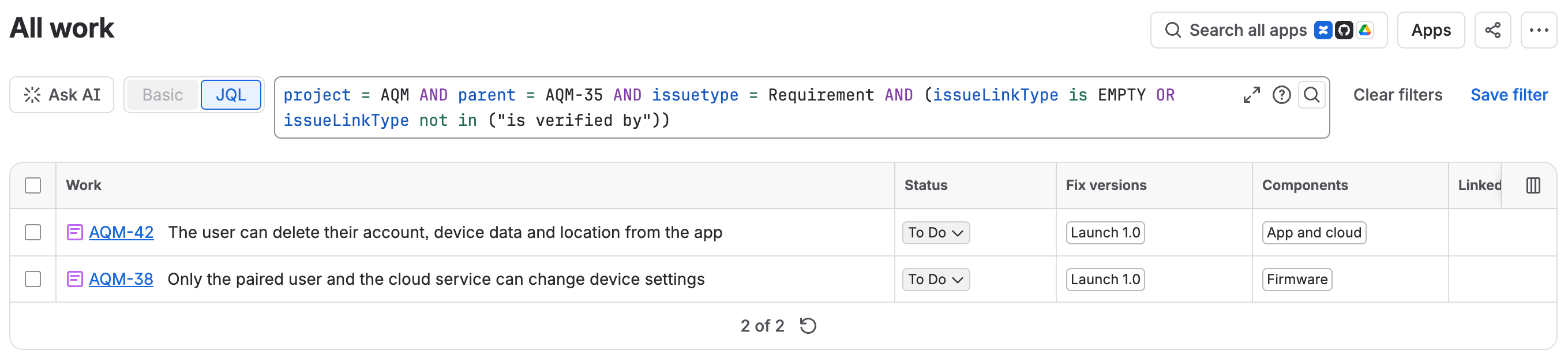 Example: two requirements without evidence, found in November instead of at the lab in March.
Keep the is EMPTY OR part of the first search: without it, requirements with no links at all, which are exactly the ones you’re looking for, drop out. Our traceability guide explains why, along with other link searches.
How does this fit the build plan?
Security work follows the same builds as everything else. Most of the evidence can only be produced on hardware that is close to final, so it lands in DVT, and the lab test sits between DVT and launch.
- EVT: the scope decision is made, and the requirements are written and owned. Restricted options are decided now, while the setup flow and bootloader are still being designed.
- DVT: tests run on production-intent hardware and firmware; gaps and failures are fixed or turned into design changes.
- Before launch: the lab assessment, the conformity route confirmed, the technical documentation complete.
- After launch: changes to the setup flow, update mechanism or network behavior re-open the affected requirements, and the CRA readiness work runs toward 11 December 2027.
If you hold stage gates, put “EN 18031 evidence complete for DVT scope” in the DVT gate criteria, linked to the epic. The EVT, DVT and PVT guide shows how gate criteria live in Jira.
What goes wrong most often?
- The scope decision is never written down. A year later nobody remembers why part 2 was in or out, and the question comes back with every new variant.
- The password decision is made by UX, alone. A friendly “skip for now” button turns a self-assessment into a notified body assessment.
- Evidence lives in the lab report only. The report arrives, a finding comes back, and nobody can tell which requirement and which firmware build it belongs to.
- The CRA date isn’t on the plan. Units planned for early 2028 are treated as if the RED assessment still covers them.
- “Not applicable” without a reason. It looks like a gap to anyone who reviews it later.
What about the UK?
Great Britain has its own regime for consumer connectable products under the Product Security and Telecommunications Infrastructure (PSTI) Act. It has applied since 29 April 2024 and covers three things: no universal default or easily guessable passwords, published information on how to report security issues, and published information on the minimum security update period. If you sell in both markets, track the PSTI items as their own requirements in the same epic, because the evidence overlaps but the obligations don’t.
Sources
- European Commission, Radio Equipment Directive (RED): Delegated Regulation 2022/30, application from August 2025, repeal by Delegated Regulation (EU) 2026/339.
- European Commission, Guide to the Radio Equipment Directive 2014/53/EU, October 2026: sections 1.7.2 (internet-connected and wearable radio equipment) and 10.9.4 (Cyber Resilience Act).
- European Commission, Guidance on the application of the harmonised standards series EN 18031:2024 in support of Commission Delegated Regulation 2022/30 (restrictions 1 to 4, Module A).
- European Commission, harmonised standards for radio equipment and summary list (EN 18031-1, -2, -3:2024, OJ L 2025/138, 30 January 2025, with notices).
- UK government, Regulation (EU) 2022/30 factsheet (application from 1 August 2025, exclusions).
- European Commission, Cyber Resilience Act (entry into force, reporting and main obligation dates).
- UK government, Regulations: consumer connectable product security (PSTI, in effect since 29 April 2024).
All sources checked 25 November 2026. The Jira searches were run on our sample space the same day.
The Hardware Stage-Gate Readiness Check: 18 questions, about six minutes, your score right away.
Questions people ask
Is EN 18031 mandatory?
The requirements are mandatory for radio equipment in scope of Delegated Regulation (EU) 2022/30; the standards are voluntary. Applying EN 18031 is the usual way to show conformity, because a harmonised standard applied in full, without its restricted options, gives a presumption of conformity. You can meet the requirements another way, but then a notified body has to assess the product.
Do we need a notified body for EN 18031?
Not always. The European Commission's guidance says self-assessment (Module A) is allowed only if the relevant EN 18031 standards are applied and the product isn't affected by the restrictions. If your device lets users not set a password, if a toy or childcare product doesn't ensure parental or guardian access control, or if EN 18031-3 clause 6.3.2.4 applies to it, a third-party assessment is needed.
What happens to EN 18031 when the Cyber Resilience Act applies?
Delegated Regulation (EU) 2026/339 repeals the RED cybersecurity regulation as of 11 December 2027. According to the Commission's RED Guide, radio equipment placed on the EU market on or after that date is subject to the Cyber Resilience Act for cybersecurity, not to Article 3(3)(d) to (f) of the RED, subject to the CRA's transitional provisions.
Does EN 18031 apply to medical devices?
The UK government's factsheet on Delegated Regulation 2022/30 lists medical devices under Regulations (EU) 2017/745 and 2017/746 among the exclusions, and the Commission's RED Guide notes that the Cyber Resilience Act generally excludes products covered by specific rules such as medical devices. Medical device cybersecurity is handled under the medical device rules instead.
Does EN 18031 apply in the UK?
Great Britain has its own regime for consumer connectable products under the Product Security and Telecommunications Infrastructure (PSTI) Act, in effect since 29 April 2024. It bans universal default and easily guessable passwords and requires manufacturers to publish how to report security issues and the minimum security update period.